
 “The Morning Journey” program, hosted by Galia Natour Kadour, interviewed Sheikh Abd Elsalam Manasra about the recent Interfaith Peacebuilder Training in Germany earlier this month.
Listen to the program in Arabic here or click below. Abd is interviewed from 24:15- 33.40 in the program.
The Abrahamic Reunion brought 12 young peacebuilders from Israel and Palestine to Germany for a week of trauma-informed peacebuilding work, sponsored by Abrahamic Reunion Germany, The United Religions Initiative, and the Foundation for Expanding Horizons.
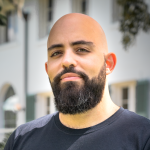 Sheikh Abd Elsalam Manasra is the Interreligious Dialogue Expert for Rising Tide International, Israeli Programs Director for Abrahamic Reunion.
Interview Text Translation:
Interviewer:
The Abraham Reunion Society in the Holy Land is organizing a project that brings together young people of different religions and nationalities, with the aim of creating an atmosphere of trust, understanding, and rapprochement, and developing a network of understanding to resolve conflicts through interfaith dialogue. To learn more about this project and the association’s goals, we are joined by Mr. Abd Alsalam Manasra, director of the Abraham Heritage Association in the Holy Land. Good morning, Mr. Abd Alsalam manasra.
Abd Alsalam:
Good morning, welcome.
Interviewer:
First, tell us a little about the association.
Abd Alsalam:
First, the Abraham Reunion Society is an association that focuses primarily on dialogue between different religions and sects in the Holy Land. In fact, there was an urgent and pressing need for parties that could engage in transparent and clear dialogue and deeply understand each other in order to build a network of understanding and bridges between the different components of the people in the homeland. Therefore, the association works with a group of religious leaders from different faiths to try, first and foremost, to build bridges of understanding and channels of communication, regardless of religion, of course. Belief is a personal freedom, but in order to build a healthy and peaceful nation and coexistence, and to be able to live without violence, we must understand each other more deeply. This has always been the most important goal of the association.
Interviewer:
Of course, dialogue. You mentioned religious leaders here. Usually, we talk about older people, but you have a special project in the association that focuses specifically on young people from all religions in society.
Abd Alsalam:
That is right, we have many programs, and one of the most important programs is the youth and young program to prepare a new generation of young people who are ready to understand and accept others. Today, we suffer from violence in our society and from severe trauma that affects everyone because of war and many other events that we suffer from in our societies, whether in our Arab society or Israeli society.
Interviewer:
My question is: To what extent does everything related to dialogue based on differences between religions and these bridges between religions attract the attention of young people, Mr. Abd Alsalam?
Abd Alsalam:
Yes, it does attract interest, because many young people, especially after the war and particularly at the present time, have a greater appreciation for the meaning of a safe and peaceful life. We are suffering; our society is being consumed by extreme violence. That is one thing. Second, wars tear apart many aspects and images of our lives, so there is a dire need to build a better future through understanding and empathy. First, to define my identity, dialogue means not only understanding the other, but mutual understanding. It is also an expression of myself, my identity, and my position, whether I am Israeli or Palestinian. The dialogue table is also a table where we meet eye to eye, as equals, and can better explain ourselves and express our existence and our rights. We can also understand different points of view and thus find solutions to problems through dialogue and understanding.
Interviewer:
Considering all the circumstances and what the region and the country have been going through over the past two years, to what extent has this affected all these discussions and debates, Professor Abd…
Abd Alsalam:
There is a significant impact. People in general have come to appreciate the meaning of living in peace, especially after the wars we have witnessed. The political arena is also highly active, even if it is driven by unrest, and even if some parties and governments may be more radical than others, which could lead us or drag us into a situation that the majority of people reject. There are also many different sects and religious groups in the country who appreciate the meaning of living in peace, and who appreciate the meaning of understanding others or recognizing the rights of others.
Interviewer:
So, in principle, the people who join you are people who believe in peace?
Abd Alsalam:
Yes, many people who believe in peace. There are also people who are only interested in dialogue as a means of defending themselves or their point of view. We always encourage and favor joining the dialogue regardless of the goal, because it is the best and safest alternative.
Interviewer:
So, this dialogue table sometimes witnesses heated discussions? Different points of view? Or are the people who are there, as we mentioned, really peace lovers who want peace? So, there is some kind of agreement?
Abd Alsalam:
No, no, not necessarily. Basically, we don’t just work on things that are similar and on which we agree. First, we try to identify and explain the importance of difference. Difference is fundamental and natural in life. Yes, we are similar in many ways, but we are also different. Therefore, clarifying the principle of difference and distinguishing between difference and disagreement is very essential and fundamental, and we try to explain it in various ways. For example, one of the programs we offer in our meetings for young and old alike is the study of religious texts. At the beginning, we show the extent of the similarities and also the extent of the differences. But does this difference necessarily lead to conflict? This is where the questions lie. Many people who try to join such dialogues come with different points of view. We basically want a plurality of views and for them to be different, because it is only possible to build and develop together if there are differences of opinion. This is where the association’s role lies, specifically in facilitating such dialogues, so that we can encourage each other to adopt such valuable principles.
Interviewer:
And what comes after the dialogues, MR. Abd Alsalam? Is there any other plan to translate all this discussion and dialogue?
Abd Alsalam:
Yes. First, we hold training sessions with young people. These are based primarily on dialogue and on explaining the principles of dialogue, agreement, and disagreement, as well as the ethics of disagreement. Second, one of the most important things we train young people on is post-trauma therapy. We have a team of psychologists who specialize in trauma healing training, to first identify the trauma we are personally experiencing and to deeply understand ourselves and the environment in which we live. For example, as I mentioned earlier, we suffer greatly from crime and violence in our communities in the Holy Land, and there are many reasons for this. Therefore, with the help of these specialists, we can also understand the environment in which we live and how to bear fruit in this environment.
When one of us is trained in trauma: What is trauma? How can we prevent trauma? How can we treat trauma? We can also influence the community around us, starting with our homes, then our friends. In this way, I can contribute to the development of society.
Interviewer:
Of course, contributing to the development of society, and also harnessing everything related to the differences between religions to build bridges between different religions. Thank you for this conversation, Mr. Abd Alsalam Manasra, Director of the Ibrahim Heritage Association in the Holy Land. Thank you for this conversation, good morning, thank you.